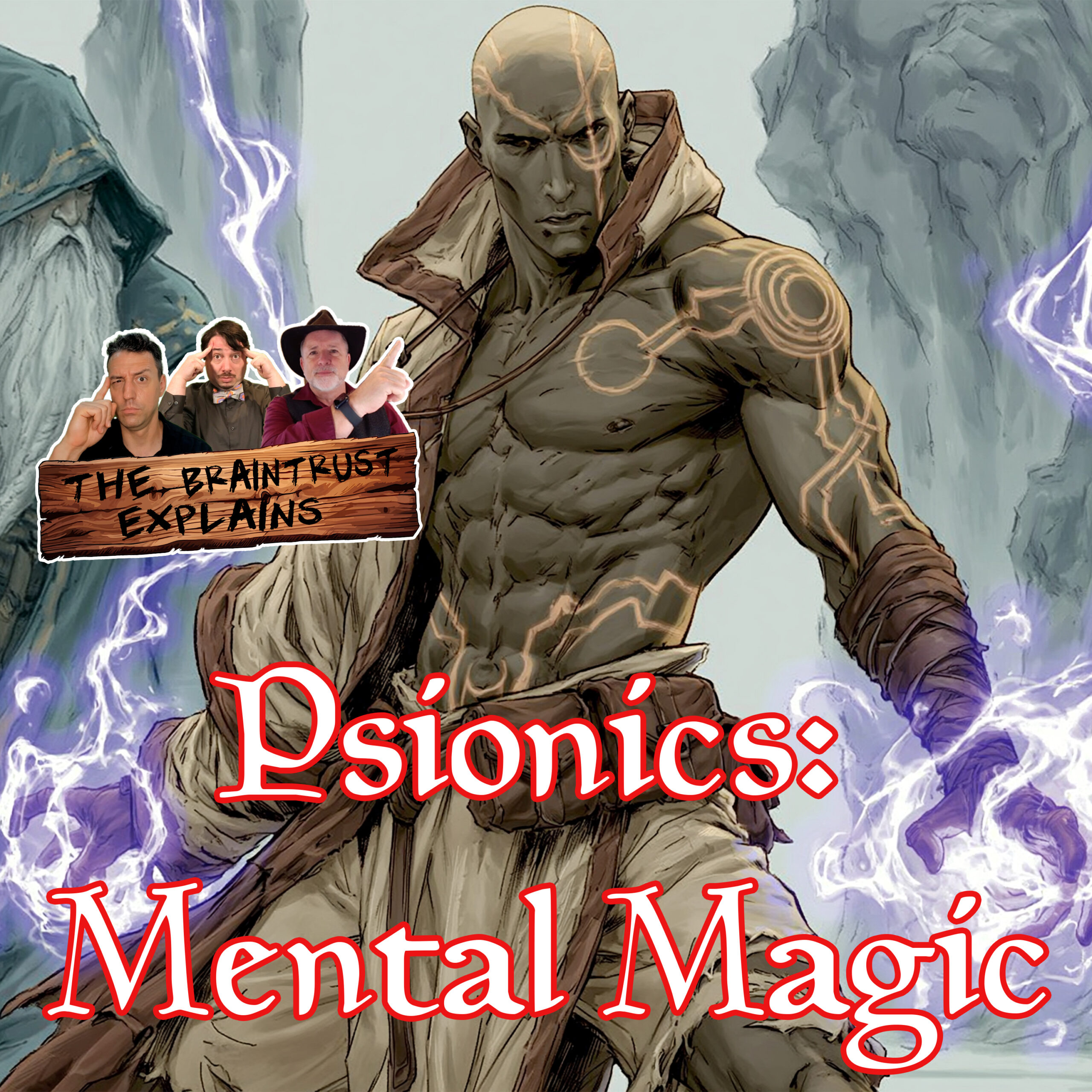
Could humans actually develop psychic powers? The science says… maybe. In this episode of FT GBT, the Brain Trust — Daniel J. Glenn, Dr. Michael Dennin, and Ben Sieper — dive into the often-overlooked world of psionics, exploring the real neuroscience and physics behind mind powers in D&D, Stranger Things, X-Men, Star Wars, and Warhammer 40K.
We break down why psychic energy works as a continuum (unlike the discrete “chunks” of arcane spell slots), and how that maps onto pop culture icons like Eleven from Stranger Things. We explore the three categories of psionic powers — attacking the mind, defending the mind, and telekinesis — and dig into the real-world science behind each: from electromagnetic brain signals and sports psychology breakdowns (Simone Biles, Ric Flair) to Faraday cages, Jedi mind tricks, and why a tinfoil hat might not be such a bad idea after all.
We also tackle the big question: can a non-psychic person defend against a psychic attack, or are they just a fish in a barrel?
Whether you’re a D&D player curious about psionics, a sci-fi fan, or just someone who’s ever wondered if you could move a remote control with your mind, this episode is for you.
🎲 Topics Covered:
- What are psionics & why they’re D&D’s most underrated subsystem
- Psychic energy as a continuum vs. discrete spell slots
- Mind attacks: ego whips, mind thrust & psychic horror
- Real-world parallels: sports psychology, CIA training, hypnotism
- Defending the brain: Faraday cages, Magneto’s helmet & Warhammer 40K
- The physics of telekinesis
- Eleven (Stranger Things), X-Men, Star Wars & psionic pop culture
- Can non-psychics resist psychic attacks?